
Agile & Adoption
What is the impact mapping?
Impact mapping is a strategic planning method that aims to properly position the vision of a project. It is a very simple visual technique that allows companies to develop and deliver work in a well-structured way.
The impact mapping can be summarized as follows:
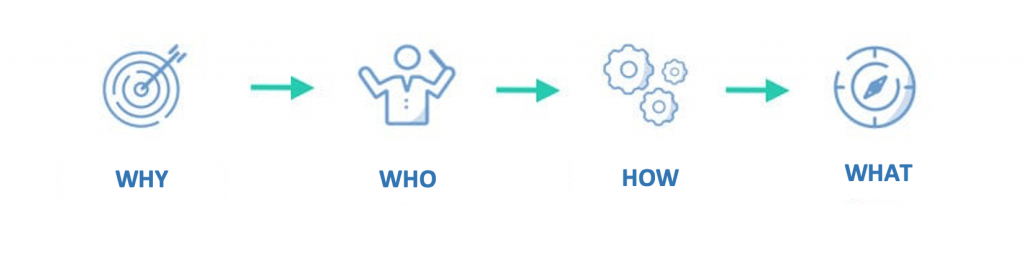
- Why: the objectives to be achieved at the end;
- Who: the actors who can help achieve these goals, who prevent them, customers, users, and who will be impacted;
- How: the impact of each actor on the progress of the project;
- What: the deliverables that will meet the defined objectives.
How to create impact mapping?
In general, impact mapping is carried out in 4 main stages:
Step 1: answer the question WHY
The first step is to determine the desired goals and write them down, explaining why it is important to achieve these goals.
Step 2: answer the question WHO
In this step, we define the actors who are the people who will contribute to the success of these objectives, the people who will block you, the customers and users, and the people who will be impacted at the end.
Step 3: answer the question HOW
In this step, we determine the different functionalities of the product.
Step 4: answer the question WHAT
The last step describes the means to be implemented to achieve the defined objectives.
Conclusion :
The impact map allows you to really determine what you want to achieve for each of your user stories. We recommend that you organize as many workshops as you can to clear up all the paths your product may cross.
What do you think? Get in touch via email to talk more!
Check out our posts on Linkedin.
<!-- ai-angle -->Mapping AI use cases to business impact
Impact mapping is a simple way to stop starting AI projects from the technology. Start from the goal, then work down.
- Why: the business goal (reduce churn, speed up onboarding).
- Who: the actors whose behavior must change (advisors, customers, back-office teams).
- How: the behavior change you need (advisors answer in one call instead of three).
- What: only now, the AI capability that enables it (a knowledge assistant, automated summaries).
Use cases that cannot be traced back to a goal and an actor go to the bottom of the backlog. It is the fastest filter we know for an AI portfolio.
This is how we work at JediSquad: see our AI transformation approach and the Agile AI Product Triangle.